

How to Size a Hydraulic Power Unit for Your Application
/ 2
Choosing the correct hydraulic power unit (HPU) is essential for achieving reliable, efficient and consistent hydraulic system performance. A HPU that is undersized may struggle to deliver the required pressure or flow, while an unnecessarily large unit can increase energy consumption, equipment costs and physical footprint.
So, how do you size a hydraulic power unit correctly?
The answer depends on several factors, including the required hydraulic pressure, flow rate, actuator requirements, duty cycle, available power supply and the environment in which the system will operate.
In this guide, we explain the key considerations when sizing a HPU and what information you should provide to a hydraulic engineering specialist.
What Is a Hydraulic Power Unit?
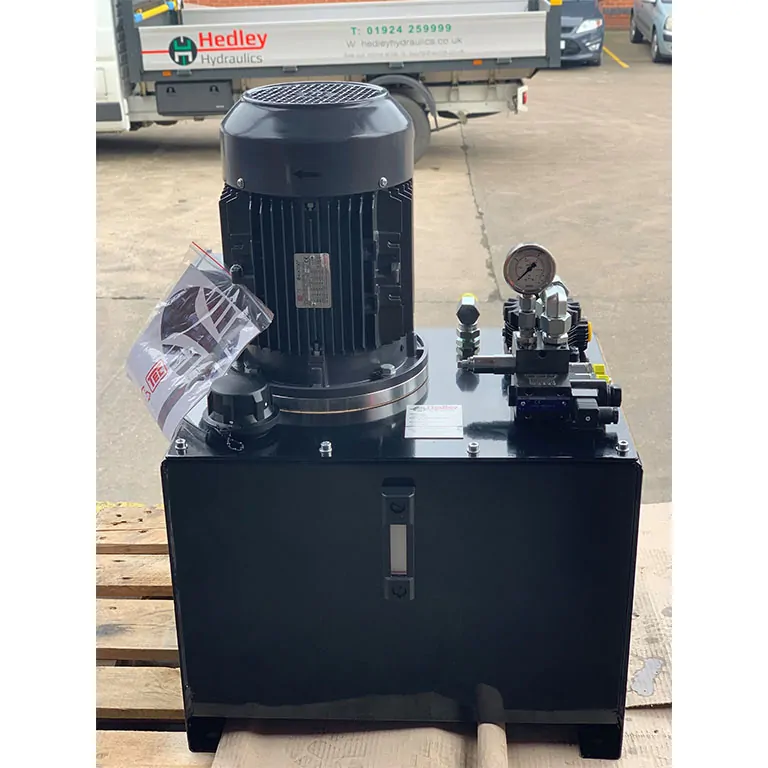
A hydraulic power unit is the central source of hydraulic power within a hydraulic system. It typically combines a hydraulic reservoir, pump, motor or engine, valves, filtration and control components to provide hydraulic fluid at the pressure and flow required by the application.
HPUs can range from relatively compact units for straightforward applications to large, bespoke systems incorporating multiple pumps, reservoirs and sophisticated control systems.
At Hedley Hydraulics, hydraulic power units are designed, manufactured and tested in-house, with power capacities ranging from less than 0.09kW to more than 500kW.
- Determine the Required Hydraulic Pressure
The first consideration when sizing a HPU is the pressure your system needs to operate effectively.
Pressure is generally determined by the force required from the hydraulic actuator. For example, a hydraulic cylinder lifting a heavy load will require considerably more pressure than a cylinder performing a low-force positioning task.
A simplified relationship is:
Force = Pressure × Area
This means the required cylinder bore, operating pressure and desired output force all need to be considered together.
The HPU should be capable of providing the required working pressure while allowing an appropriate margin for the application. However, simply selecting a pump with the highest possible pressure is not necessarily the correct approach.
Components including pumps, valves, hoses, cylinders and fittings must all be suitable for the intended operating pressure.
- Calculate the Required Flow Rate
Flow rate determines how quickly hydraulic actuators can move.
For a hydraulic cylinder, the required flow depends on the cylinder’s internal area and the desired extension or retraction speed. For example, if an application requires a cylinder to extend quickly, the HPU needs to deliver sufficient flow to achieve that movement within the required time. Multiple actuators can make this calculation more complicated. If several cylinders need to operate simultaneously, the HPU may need to provide the combined flow requirements. However, if the actuators operate sequentially rather than simultaneously, the required pump flow may be considerably lower. This is why understanding the complete hydraulic circuit is important when selecting an HPU.
- Consider the Duty Cycle
How frequently will the hydraulic system operate?
A HPU designed for intermittent operation may have very different requirements from one running continuously throughout a production shift.
Consider:
- How many cycles are required per hour?
- How long does each cycle last?
- How long does the pump operate continuously?
- Does the system regularly operate at maximum pressure?
- Are there periods when the system is idle?
The duty cycle can affect motor sizing, pump selection, reservoir capacity and cooling requirements.
A system operating continuously under high load may require additional thermal management to prevent excessive hydraulic fluid temperatures.
- Select the Appropriate Pump
Pump selection is another important part of HPU sizing.
The pump must provide the required flow and pressure while being suitable for the application and expected duty cycle.
Depending on the system, the design may incorporate gear, vane or piston pumps, with the appropriate configuration selected according to pressure, flow, efficiency and operating requirements.
For more complex applications, a multi-pump arrangement may be appropriate. This can allow different parts of a system to operate at different flow or pressure requirements.
Hedley Hydraulics designs bespoke HPUs using components from established hydraulic manufacturers and can develop solutions around the specific requirements of the application.
- Calculate Motor Power Requirements
Once the pressure and flow requirements have been established, the hydraulic power requirement can be calculated.
A commonly used hydraulic power calculation is:
Hydraulic power (kW) = Pressure (bar) × Flow (L/min) ÷ 600
This gives the theoretical hydraulic power requirement. In practice, the motor needs to account for losses within the pump, motor and wider hydraulic system.
This means the motor should not simply be selected based on the theoretical calculation alone.
Efficiency, starting conditions, duty cycle and the characteristics of the selected pump all need to be considered.
- Consider Reservoir Size
The hydraulic reservoir stores the system’s hydraulic fluid and performs several important functions.
It provides a supply of fluid to the pump while allowing heat dissipation, air separation and contamination management.
Reservoir sizing depends on factors including:
- Pump flow rate
- Duty cycle
- Available space
- Operating temperature
- Cooling requirements
- Fluid requirements
- System configuration
There is no single reservoir size that is suitable for every HPU.
For bespoke systems, the reservoir can be designed around the application’s physical and operational requirements rather than forcing the system to fit a standard package.
- Don’t Forget Filtration and Cooling
Filtration is critical to maintaining hydraulic system reliability.
Contaminated hydraulic fluid can accelerate wear in pumps, valves, cylinders and other components. The HPU therefore needs appropriate filtration for the system and its operating environment. Cooling requirements also need to be considered, particularly where the HPU operates continuously or under high load. Depending on the application, the HPU may incorporate features such as return-line filtration, pressure-line filtration, oil coolers, oil heaters, level switches and temperature monitoring.
- Consider the Physical Installation
A HPU can have the correct hydraulic specifications but still be unsuitable if it cannot be installed effectively.
Before finalising the design, consider:
- Available floor or platform space
- Access for maintenance
- Environmental conditions
- Noise requirements
- Pipework and hose routing
- Electrical connections
- Lifting and transportation requirements
- Access to filters, valves and inspection points
For larger or complex installations, 3D CAD modelling can be particularly useful.
Hedley’s hydraulic design team uses SolidWorks to develop 3D models and optimise the layout of hydraulic systems before manufacture.
Bespoke HPU Design vs Standard Hydraulic Power Units
For straightforward applications, a standard HPU may provide everything required. However, bespoke design can be advantageous when an application has unusual pressure or flow requirements, limited installation space, multiple operating conditions or specific industry requirements. A bespoke HPU can be designed around the application rather than adapting the application to a standard unit. Hedley manufactures both standard and bespoke hydraulic power units, with the ability to provide complete solutions from design through to manufacture, testing, installation and commissioning.
What Information Do You Need to Size an HPU?
When discussing a HPU requirement with a hydraulic engineer, it is useful to provide as much information as possible.
This should include:
- Required operating pressure
- Maximum system pressure
- Required flow rate
- Cylinder or motor specifications
- Required actuator speed
- Number of actuators
- Simultaneous or sequential operation
- Duty cycle
- Available electrical supply
- Operating environment
- Hydraulic fluid
- Space restrictions
- Control requirements
- Cooling requirements
- Any relevant industry or project standards
The more information available at the design stage, the easier it is to develop a HPU that provides the required performance without unnecessary capacity or cost.
Why Correct HPU Sizing Matters
Correct hydraulic power unit sizing is about more than simply selecting a pump and motor. The complete system needs to work together efficiently and reliably. Pressure, flow, power, reservoir capacity, filtration, cooling, controls and physical installation all need to be considered as part of the overall design. An incorrectly specified HPU can result in poor actuator performance, overheating, excessive energy consumption, premature component wear and unnecessary downtime. Working with an experienced hydraulic engineering company can help ensure these factors are considered before manufacture.
Need Help Sizing a Hydraulic Power Unit?
Hedley Hydraulics can design, manufacture, test, install and commission hydraulic power units for a wide range of industrial applications.
Our engineering team can assess your application requirements and develop a hydraulic power unit designed around the pressure, flow, duty cycle and installation requirements of your system.